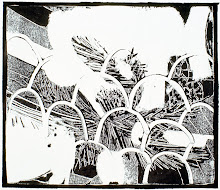
"Always, Mrs. Ramsay felt, one helped oneself out of solitude reluctantly by laying hold of some little odd or end, some sound, some sight. She listened, but it was all very still; cricket was over; the children were in their baths; there was only the sound of the sea. She stopped knitting; she held the long reddish-brown stocking dangling in her hands a moment. She saw the light again. With some irony in her interrogation, for when one woke at all, one's relations changed, she looked at the steady light, the pitiless, the remorseless, which was so much her, yet so little her, which had her at its beck and call (she woke in the night and saw it bent across their bed, stroking the floor), but for all that she thought, watching it with fascination, hypnotised, as if it were stroking with its silver fingers some sealed vessel in her brain whose bursting would flood her with delight, she had known happiness, exquisite happiness, intense happiness, and it silvered through the rough waves a little more brightly, as daylight faded, and the blue went out of the sea and it rolled in waves of pure lemon which curved and swelled and broke upon the beach and the ecstasy burst in her eyes and waves of pure delight raced over the floor of her mind and she felt, It is enough! It is enough!"
Monday, February 20, 2012
Lemon, and Light Across the Floor of the Mind
To the Lighthouse is packed with spaces and rooms that are described through a single vivid detail, such as the "long reddish-brown stocking" dangling from Mrs. Ramsay's hand as her attention leaves the knitting and travels out the window to the landscape of the beach in late day. Woolf gives the reader the physical qualities of the stocking in such detail that the rest of the room feels bleak. In this passage, Mrs. Ramsay has become aware of her solitude in that room overlooking the sea, and in order to rescue herself from it she is hunting for a fact in her landscape on which to fasten her consciousness.

Subscribe to:
Post Comments (Atom)
No comments:
Post a Comment